
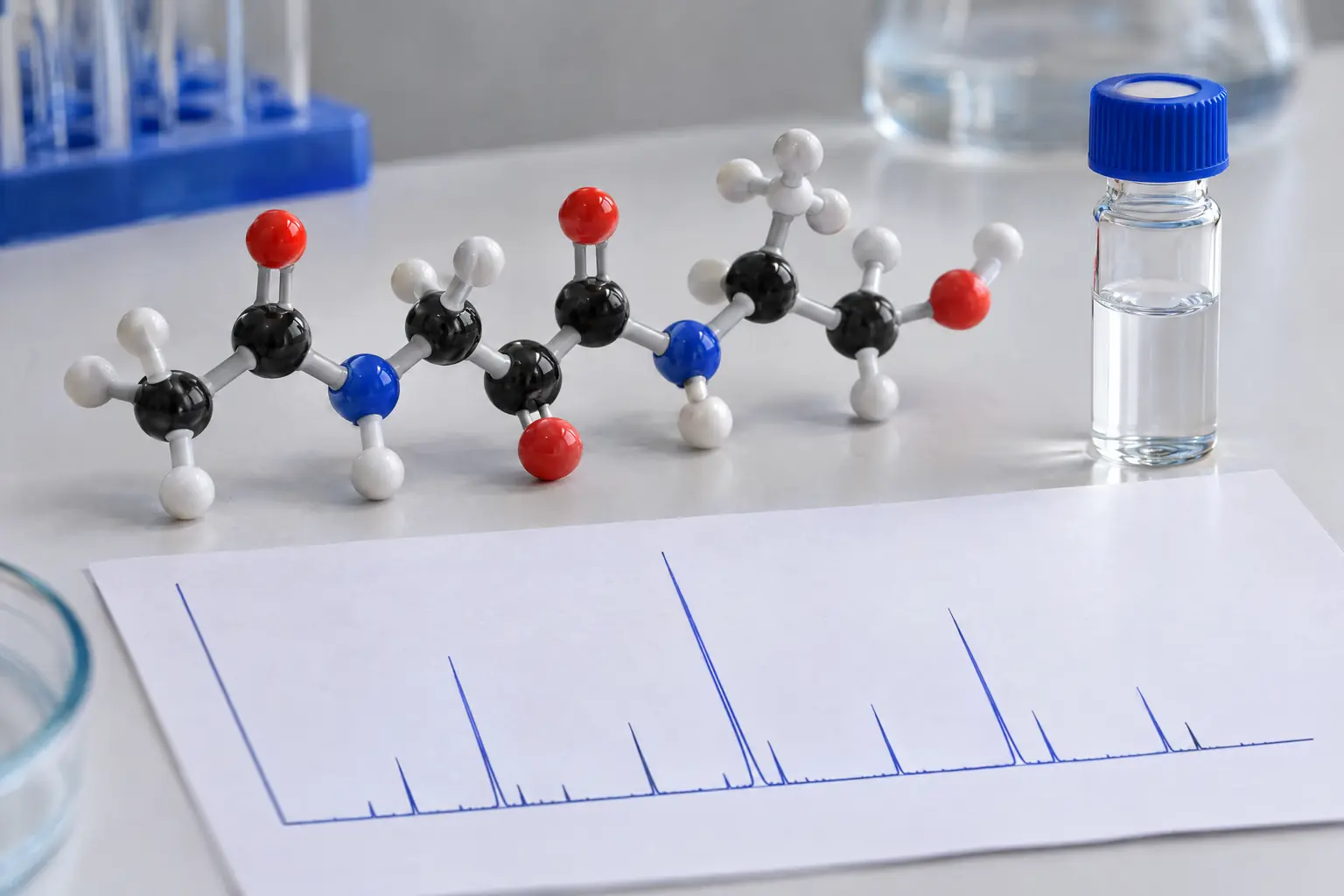
How the calculation works
The calculator builds the molecular formula from standard residue formulas, adds one water for the termini, applies the modifications you select, and only then computes the masses from IUPAC atomic masses. Because both figures come from the same formula, they always agree. It accepts the 20 standard amino acids; D-amino acids share the mass of their L-forms, and unusual residues or other modifications are not covered.
The example is BPC-157 (GEPPPGKPADDAGLV), C62H98N16O22, average molecular weight 1419.53 g/mol.
Theoretical mass is not a test result
A calculated mass tells you what the named peptide should weigh. It says nothing about what a vial holds. A certificate reports what was measured: identity against reference data, chromatographic purity and, on request, the milligrams of peptide in the vial. Theoretical mass and observed mass in the glossary.
Questions
How is the molecular weight of a peptide calculated?
Add the residue masses of each amino acid (each amino acid minus one water, lost when the peptide bond forms), then add one water for the free N- and C-termini. Modifications adjust the formula: a C-terminal amide replaces OH with NH2, N-terminal acetylation adds C2H2O, and each disulfide bridge removes two hydrogens.
What is the difference between average and monoisotopic mass?
Average molecular weight uses the natural mix of isotopes and is the figure for weighing material, in g/mol. Monoisotopic mass uses only the most abundant isotope of each element (carbon-12, hydrogen-1 and so on) and is the figure a high-resolution mass spectrometer compares a measured peak against, in daltons.
Why does the powder weigh more than the molecular weight suggests?
Most synthetic peptides are supplied as salts. Counter-ions such as acetate or trifluoroacetate (TFA) and residual water add mass to the powder, so a vial labelled by gross weight holds less peptide than its weight. Net peptide content expresses how much of the powder is peptide.
Does a matching mass prove a sample is the right peptide?
No. Mass is one line of evidence. Isomers share a mass, and a sample can contain the right peptide alongside impurities. Identity is established by comparing the material against reference data, and purity and content are separate measurements.
Peptide analysis confirms identity against reference spectra and reports HPLC-UV purity from $250 CAD a sample. Content in milligrams per vial is added on request at no extra charge.